What is IT Support for Manufacturing & Engineering?
What is IT Support for Manufacturing & Engineering?
A plain-language guide to what makes IT support different on a production floor than in a typical office — and why the wrong provider can mean stopped machines, not just slow email.
On This Page
Overview
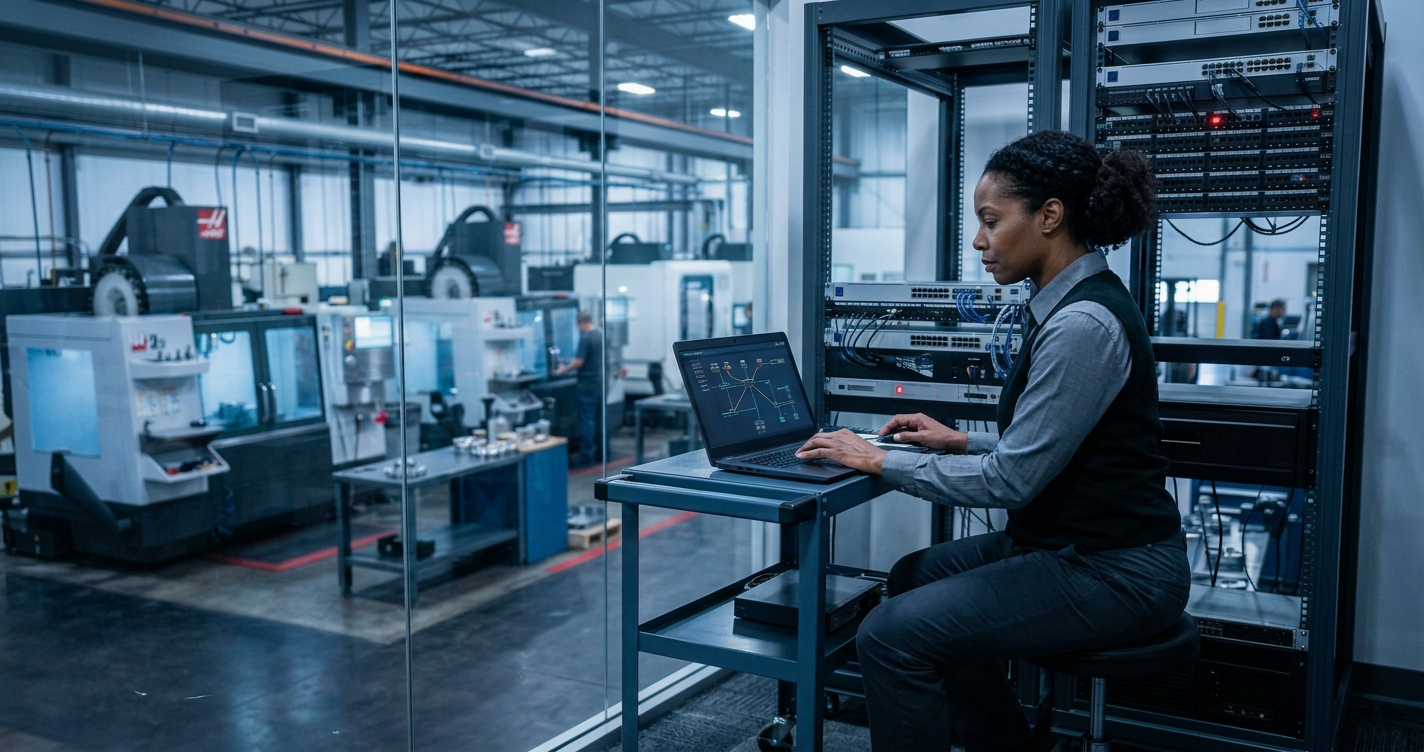
IT support for manufacturing and engineering companies covers everything general IT support does — networks, workstations, email, security — plus the systems unique to a production environment: ERP and MES platforms, machine connectivity, industrial control systems, and the network segmentation needed to keep office IT problems from ever reaching the factory floor.
The stakes are different, too. An office IT outage slows people down. A production IT or OT outage stops physical output — machines idle, shipments slip, and the cost accrues by the hour in a way that's immediately visible on the floor, not just on a help desk ticket count.
Cost of inaction example: A mid-sized manufacturer in Alabama had its office network and production floor running on the same flat network with no segmentation. A ransomware infection that started on an office workstation spread directly into the systems controlling production scheduling, halting the line for a day and a half — a scenario that proper network segmentation would have contained to the office side alone.
Benefits of Manufacturing-Specific IT Support
Common Questions About Manufacturing & Engineering IT Support
It covers the same foundation as general managed IT — network management, workstation support, email, cybersecurity, and backup — plus manufacturing-specific needs: ERP and MES system support, secure connectivity for machines and industrial control systems, CAD and engineering file management, and network segmentation between office IT and the production floor.
A provider without manufacturing experience often handles the office side competently but misses the production-floor considerations entirely, which is where the real operational risk usually sits.
Typical office IT support is built around desktops, email, and general business applications, where an outage is inconvenient but rarely urgent by the minute. Manufacturing IT support has to account for operational technology — the systems that directly control machines and production processes — where an outage can stop physical output immediately.
That difference changes priorities, response times, and network design. A provider used to office environments alone may not think to segment networks or prioritize production-floor issues the way manufacturing demands.
Operational technology refers to the hardware and software that directly controls physical processes and equipment — PLCs (programmable logic controllers), SCADA systems, and machine controllers, as opposed to IT, which covers computing and networking for information and communication.
As manufacturing has become more connected, IT and OT increasingly share the same network infrastructure, which is exactly why proper segmentation matters — without it, a security incident on the IT side can spread directly into the systems running physical equipment.
Office downtime slows individual tasks — email delays, slower file access — but work generally resumes once systems return. Production downtime stops physical output entirely: machines sit idle, labor is paid without corresponding output, and delivery commitments to customers can slip, sometimes triggering contractual penalties.
Example: A logistics-adjacent manufacturer in South Georgia calculated that even a single hour of unplanned line downtime cost more in lost throughput than a full week of typical office IT disruptions — a gap that shaped how they prioritized IT investment going forward.
Manufacturers are frequent ransomware targets specifically because downtime cost gives attackers leverage — a halted production line creates far more urgency to pay than a delayed email inbox. Legacy machine controllers and industrial equipment also often run outdated software that can't be patched the way a standard workstation can, creating long-lived vulnerabilities.
Intellectual property theft — proprietary designs, formulas, or processes — is another manufacturing-specific risk that general office-focused security doesn't always account for with the right level of access control.
CMMC (Cybersecurity Maturity Model Certification) is a Department of Defense framework requiring specific cybersecurity controls for contractors and subcontractors that handle certain categories of defense-related information. If your business supplies parts, components, or services anywhere in a defense supply chain — even as a smaller subcontractor several tiers removed from the prime contractor — CMMC requirements may apply to you.
Because CMMC scope and specific requirements are tied to your contracts and the information you handle, confirm your exact obligations with your prime contractor or a qualified compliance advisor rather than assuming either way.
A manufacturing-aware IT provider understands how your ERP or MES platform connects to production scheduling, inventory, and shop floor data — so support tickets get resolved with that context instead of treating the ERP as just another piece of office software. This includes coordinating updates, integrations, and access controls around how production actually depends on those systems.
This integration awareness is what separates manufacturing-specific IT support from general-purpose support that happens to also serve a manufacturer.
Cost depends on the number of endpoints, the complexity of production systems and OT integration, and whether compliance frameworks like CMMC are in scope. Most manufacturers find this fits within a managed IT relationship priced around endpoint count and service level, similar to other industries, with additional scope for OT-specific network segmentation and security work.
The more useful framing is comparing that cost against the cost of a single significant production outage — which, as noted above, frequently exceeds a full year of properly structured IT support.
CMMC affects manufacturers in defense supply chains. Beyond formal regulation, many manufacturers face contractual cybersecurity requirements imposed directly by larger customers or prime contractors — sometimes stricter than any government framework — as a condition of continuing to do business with them.
Reviewing customer contracts for embedded security or audit requirements is worth doing specifically, since these obligations don't always come labeled as "compliance" the way HIPAA or CJIS do.
Defense supply chain manufacturers face CMMC obligations directly. Manufacturers running continuous or high-throughput production lines feel downtime costs most acutely, since idle time compounds quickly. Companies holding proprietary designs or formulas carry higher intellectual-property risk, and those integrated tightly with a small number of major customers face outsized contractual and reputational exposure if a security incident disrupts delivery.
Example: An engineering firm in Alabama supplying custom components to a small number of large industrial customers treats IT reliability as directly tied to those relationships — a significant outage doesn't just cost internal downtime, it risks the customer's own production schedule and the relationship itself.
Look for a provider with direct experience supporting production environments — not just general office IT — who understands network segmentation between IT and OT, can speak knowledgeably about your ERP or MES platform, and treats production-floor issues with the urgency they actually warrant rather than a standard help-desk queue.
- Do they have direct experience with manufacturing or engineering clients?
- Can they explain how they segment IT and OT networks?
- Do they understand CMMC, if it applies to your supply chain position?
- Do their response time commitments reflect production-floor urgency, not just office tickets?
How AllTech Helps
AllTech IT Solutions supports manufacturing and engineering companies across Alabama, the Florida Panhandle, and South Georgia with IT built around production realities — proper IT/OT network segmentation, ERP-aware support, and cybersecurity that accounts for the specific ransomware and intellectual-property risks manufacturers face. Backup, disaster recovery, and incident response are structured with production uptime as the priority, not treated as an afterthought to office support.
Key Areas Addressed
Cybersecurity as a Service
Ongoing protection against manufacturing-targeted ransomware.
Learn more →Data Backup & Disaster Recovery
Recovery plans built around production uptime, not just data.
Learn more →The AllTech Approach to Manufacturing & Engineering IT
- Segment IT and OT networks so office issues can't reach production systems.
- Prioritize production-floor issues with response times that reflect actual downtime cost.
- Coordinate support around your ERP/MES platform, not just general office software.
- Assess CMMC and contractual security obligations tied to your supply chain position.
- Structure backup and recovery around uptime, treating production continuity as the priority.
Resources
Is your office network one incident away from stopping your production line?
AllTech IT Solutions supports manufacturing and engineering companies across Alabama, the Florida Panhandle, and South Georgia.
Call 205-290-0215